

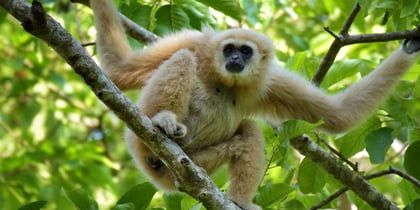
The Gibbon, a great ape, is one of the most endangered species in the world. Only 10 of the Hainan Gibbon, found on the South China island of the same name, are still alive. But what about the most endangered resources?
Of all endangered animals and plants there is a list, the red list, of the International Union for Conservation of Nature (IUCN). It keeps track of the status of all species. An increasing proportion of the animals on the list are listed as endangered, and their populations as declining. More than a quarter of all living species are threatened with extinction: that's almost 50,000 species.
Such a list also exists for commodities. The European Commission has currently labeled 34 metals and minerals as critical raw materials. This is not just about how much of these still exist on and in the earth, but mainly about how necessary these raw materials are for the energy transition and how difficult it is to obtain them in Europe.
Necessary for the energy transition
These critical raw materials are mostly rare earths that are needed to make wind turbines, batteries and solar panels for the energy transition, but also for microchips for the digitalization of our society. Critical raw materials include barite, bismuth, cobalt, magnesium, manganese, strontium, tantalum and fluorspar.
For these eight, the Netherlands is largely dependent on China, which is the world's largest producer of these critical materials. Last year, we purchased 274 million euros worth of magnesium from the Chinese and 178 million euros worth of manganese, according to recent CBS figures.
Manganese and Gibbon
Manganese is an important mineral for battery production because it is a hard material and prevents corrosion. Manganese is also needed for making wind turbines. On a global scale, manganese is by no means the Gibbon monkey of raw materials, with a stockpile of 1,900 million tons and production of 20 million tons, but on a European scale it is. Apart from Ukraine, officially not (yet) an EU member, no European country has a substantial amount of manganese in its (sea) soil.
Europe has few critical materials anyway. Portugal has lithium, Greece has nickel and Finland has cobalt, but otherwise it is meager, especially compared to the reserves of cobalt in Congo and nickel in Indonesia. This makes Europe vulnerable and dependent. Business is logically affected.
Research on raw material scarcity
Just under half of the companies surveyed (48 percent) expect raw material scarcity to result in higher prices for both products and services. This is according to research by Milgro among 311 Dutch and Belgian companies. They anticipate having to pass on some of this cost increase to their end customers. About the same percentage says they depend on scarce raw materials. And for seven percent, raw material scarcity poses a threat to business continuity.
To reduce dependence on raw materials, the European Commission has established Critical Raw Material Act (CRMA). The goal: to extract 10 percent of Europe's annual consumption of these strategic raw materials in Europe itself by 2030, to refine 40 percent in Europe and to recycle 25 percent.
In the latter lies great potential and an opportunity to boost the raw materials transition. Because many of the critical materials can be recovered and reused. For example, a factory opened last year in the Port of Rotterdam that recovers materials from batteries, such as lithium and cobalt. And Back to Battery is a startup that can recycle batteries.

Commodity transition
Business can also contribute to this raw material transition. This requires a shift from the linear use of raw materials to circular use. Instead of using materials once and then throwing them away, it's all about reuse, preserving value and preventing waste. By reusing raw materials, we become less dependent on primary resources, strengthen the competitive position of companies and reduce the pressure on the earth.
China soon dependent on the Netherlands?
And what about the Gibbon? In the Netherlands, programs are set up in zoos to maintain the global population of Gibbons. There are Gibbons in Wildlands and the Apenheul, among others, and a Dutchman leads a breeding program for these monkeys in Portugal. Who knows that because of Gibbon scarcity, China may one day become as dependent on the Netherlands as it currently is the other way around for the resource threat.
Stay informed!
Want to stay up to date with the latest developments? Follow us on LinkedIn and Instagram or subscribe to our newsletter. Curious about what Milgro can do for your operations and waste process? Feel free to get in touch .
Stay informed
Follow us on LinkedIn. Here we share the latest news on regulations, circular topics and developments in the industry. You can also subscribe to our newsletter. Curious what Milgro can mean for your operations and waste processes? Feel free to get in touch.
.jpg?width=380&name=Uitgelichte%20afbeelding%20(79).jpg)