




Circularity is a term that is increasingly appearing in business strategies, but what does it actually mean in practice? Many organizations think primarily of recycling or waste management. This is understandable, because reusing materials is visible and concrete. But circularity goes further: it is a strategic choice that helps companies use scarce resources smarter, stimulate innovation and ensure continuity.
Circularity is not an afterthought. It is a way to manage risks, strengthen competitiveness and create new opportunities. From strategic independence to developing circular business models, the impact extends beyond the environment alone. But how do you turn this ambition into concrete action? That is the challenge many companies now face.
Circularity: a strategic choice
Circularity is not just a way to comply with laws and regulations or as a response to scarcity. It is a way to achieve strategic benefits:
- Less dependence on unstable suppliers, making companies less vulnerable to geopolitical fluctuations and resource scarcity.
- Cost control and security of supply, as smart management of materials reduces the impact of price increases and shortages.
- Innovation and new business models, as circular design opens up opportunities for distinctive products and services.
- A strong employer brand and higher customer value, because companies with a circular strategy are more attractive to talent and customers who value sustainability.
Thus, circularity is a long-term strategy that supports business continuity and competitiveness.
Why circularity is urgent: geopolitics and resource scarcity
The Netherlands and Europe are highly dependent on imported critical raw materials. This dependence entails risks. Some examples:
- 60% of global cobalt mining takes place in the Democratic Republic of Congo, while rare earths are almost entirely refined in China, which is part of the European strategy around critical raw materials.
- Some countries are using their position strategically, resulting in higher prices and uncertainty in the supply chain, reinforcing the focus on domestic production and diversification.
- Dutch recyclers are struggling to compete with cheap virgin materials from outside Europe, a trend that underscores why circular policies must go beyond recycling (as also highlighted in the latest ICER report).
These examples show that access to raw materials cannot be taken for granted. Circularity helps companies reduce these risks by making better use of existing materials, extending their lifespan and designing products to allow for reuse.

Recycling alone is not enough
Many organizations still equate circularity with recycling. However, recycling alone is not sufficient — particularly when it comes to critical raw materials and long-term resource security.
A successful circular economy strategy requires a broader, systemic approach:
- Product life extension: Designing products for durability, repair and preventive maintenance to maximize value retention.
- Design for reuse and disassembly: Developing components that can be easily reused, refurbished or taken apart at end of life.
- Circular business models: Shifting from ownership to service-based models that keep materials and products in closed loops.
- Supply chain collaboration: Engaging suppliers, processors and customers to align on shared circular goals and data transparency.
By integrating these strategies, companies not only reduce their environmental footprint but also strengthen competitiveness, improve resource efficiency and enhance long-term strategic resilience.
Circularity in practice: renewable energy as an example
The energy transition shows that circular thinking is crucial. Modern wind turbines consist of thousands of parts, many of which are theoretically recyclable. Yet only a small portion is actually reused. Photovoltaic solar panels have a lifespan of about 25 years, but high-quality recovery of copper, aluminum and glass laminate is largely absent.
So even technologies that appear "green" are not automatically circular. It starts with design, business model and understanding of material flows, not waste that is later recycled.

From ambition to action
Making circularity concrete requires a planned approach. Key steps are:
- Inventory material flows and critical raw materials to understand risks and opportunities.
- Design products for reuse and maintenance so that materials have multiple life cycles.
- Invest in circular business models, for example by offering products as a service.
- Encourage collaboration in the chain, from suppliers to customers, to close material flows.
- Measure environmental impact and business performance so that results are transparent and adjustments can be made.
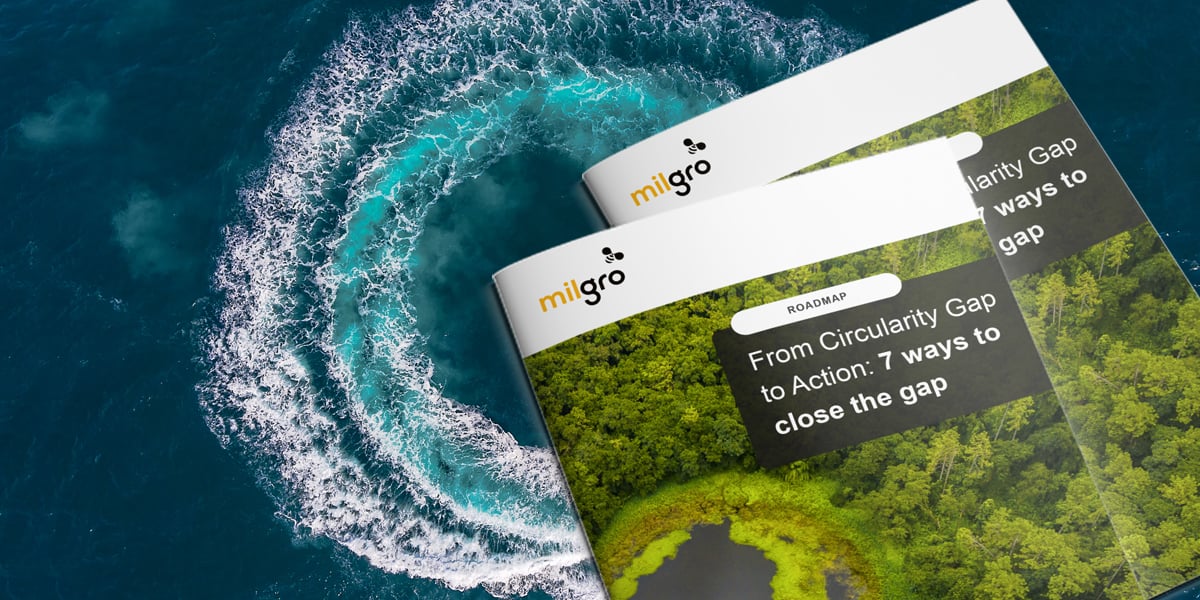
Want to get started right away? Download our report "7 ways to close the gap" , a concrete roadmap to move circularity from ambition to execution.
Circularity is not a trend and recycling is only one component. For companies, it is a strategic choice that helps:
- Manage scarcity and geopolitical risks.
- Reduce costs and increase security of supply.
- Develop innovation and new business models.
By cleverly integrating circularity into strategy, design and business model, you build a future-proof company ready for the challenges of today and tomorrow.
Want to take the next step?
Download the free step-by-step guide and turn your circular ambitions into measurable action.

Stay informed
Follow us on LinkedIn. Here we share the latest news on regulations, circular topics and developments in the industry. You can also subscribe to our newsletter. Curious what Milgro can mean for your operations and waste processes? Feel free to get in touch.
.jpg?width=380&name=Uitgelichte%20afbeelding%20(52).jpg)