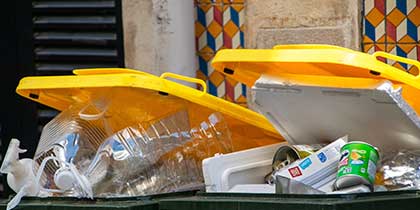




Portugal is a country full of history, colorful streets and picturesque squares, from the university city of Coimbra to Lisbon's bustling boulevards and Porto's markets. Between historic tiles and bustling squares, however, lies a lesser-known story: how is waste management in these cities? While some places are neatly set up for waste separation, in crowded tourist locations litter piles up quickly.
The blog series "A look at waste from..." looks beyond the borders of the Netherlands and Belgium. How do other cities and countries deal with their waste streams? What can be learned from them and what not? In this blog you can read all about these three cities in Portugal.
In Lisbon in 2022, about 579 kilograms of waste was produced per inhabitant, of which only 30% was collected separately. For reference, in Amsterdam the waste production per inhabitant is lower, with an average of 367 kilos per year, and about 22-32 % is collected separately, below the Dutch national average of about 60 %.
Litter in tourist hotspots
In Coimbra, Porto and Lisbon, it was noticeable that litter is surprisingly high in some tourist locations, especially in places with a lot of pedestrians or where several people with no fixed residence congregate. The limited number of public litter bins contributes to this, leading to accumulations of litter. In addition, cigarette butts are a common type of litter, indicating the challenge of small litter that arises quickly but is difficult to dispose of.
At the national level, Portugal is still struggling to get its waste figures right: the recycling ratio of municipal waste was around 30% in 2022, well below the EU average of nearly 49% and well below European targets.
Public space and waste infrastructure
In some urban environments, there are sufficient trash bins, for example at airports, in universities and near parliament. There is often also the possibility of waste separation, and this is reasonably well implemented in practice. This is in line with national policy frameworks such as the Strategic Plan for Urban Waste (PERSU 2030), a Portugal-wide action plan that aims to improve waste prevention, separate collection and recycling to meet European targets for 2030 and 2035.
Investmentshave recently been announced to strengthen recycling and waste valuation, such as a €30 million project for selective collection and composting initiatives.
Transport hubs and urban logistics
Public transport hubs such as train stations and bus stations have relatively many waste bins, making it easier to dispose of waste and reducing litter. At the same time, Portugal is at risk of failing to meet EU recycling targets by2025 (at least 55% recycling of municipal waste), and targets around packaging waste and landfill reduction also seem difficult to achieve without additional efforts.
And Portugal is actively investing in selective collection and composting centers, including through a €30 million project to modernize infrastructure and recycling.
Hotels, hostels and private spaces
In accommodations such as hotels and hostels, separate waste bins are often not available in public areas. This points to differences in waste collection and use between public and private spaces: public places are more likely to invest in infrastructure, while private facilities do not always do so yet. There are opportunities here to expand awareness and facilities for waste separation.
Waste generation and urban statistics
As mentioned earlier, only a small portion of municipal waste is collected separately. Portugal generates slightly less municipal waste per capita than the EU average, but remains relatively dependent on landfills and energy recovery rather than recycling. This indicates that closed waste chains have not yet been achieved everywhere.
Policy and practice
Infra deficiencies in busy tourist areas contribute to litter, while good waste separation in specific locations shows what is possible with the right infrastructure. Hotels and tourist accommodations are logical focal points for improvement, and small waste such as cigarette butts requires targeted initiatives such as special bins and awareness campaigns.
Portugal and other EU countries have ambitious targets: at least 55% recycling of municipal waste by 2025, 60% by 2030 and 65% by 2035, and reducing landfills to no more than 10% by 2035(Amcs, 2025).
Investments in better sorting and recycling infrastructure, partly funded by European and national programs, show that there is movement, but implementation and further investment remain crucial.
Work to be done!
Coimbra, Porto and Lisbon show that urban waste management still has plenty of challenges, from litter to limited separation possibilities. However, Portugal is making great strides: by 2025,55% of municipal waste should berecycled, 65% by 2035, and landfills should contain no more than 10% of waste. Whether the target has been met in Portugal and its cities has not yet been published.
But with major investments in modern sorting facilities, collection structure and awareness campaigns, citizens and organizations are being actively involved. A clear route to circular waste management is thus emerging, in which streets become cleaner and materials are maximized for reuse. Although Portuguese cities still have a long way to go. Show Portugal that ambition, policy and local implementation together can make a real difference!

Read also

A view of waste from New York
Staying informed!
Want to stay up to date on all new developments? Follow us onLinkedIn,or subscribe to the newsletter. Are you curious about what Milgro can do for your operations and waste process? Then get in touch.
Stay informed
Follow us on LinkedIn. Here we share the latest news on regulations, circular topics and developments in the industry. You can also subscribe to our newsletter. Curious what Milgro can mean for your operations and waste processes? Feel free to get in touch.
.jpg?width=380&name=Uitgelichte%20afbeelding%20(82).jpg)