




Good waste separation does not start with good will, but with good design. That is the gist of recent European research on waste separation labels. Once systems are confusing, people drop out, regardless of their motivation. The EU tested thousands of citizens, talked to hundreds of stakeholders and compared numerous design variants. The conclusion is clear: small design choices have a huge impact on behavior. In this blog, we show why labels often fail, what does work and how your organization can get started right away.
Why current labels confuse people
Many existing labels do not align with how people make choices. Problems often arise from design: icons are unclear, colors inconsistent, text too small or too technical, and multi-component packaging creates doubt. National differences amplify this effect. The result? Lower sorting accuracy, frustration and valuable materials that end up unnecessarily in residual waste.
What does work: design principles that score consistently
Effective labels put the focus on what something is, not where it should go. Simple pictograms, low visual noise and clear material designations reduce doubt. EU tests show that almost everyone immediately recognizes whether something is made of paper, cardboard or glass when the pictograms are uniform and clear(96% recognition!).
In addition, color can be a powerful behavioral trigger. Correct use of color increases sorting accuracy in mono-material packaging by up to 40%. It is important that colors are applied consistently, have sufficient contrast, do not conflict with other codes (such as safety) and are accessible to color blind people.
The optimal combination always appears to be threefold: pictogram, color and simple text. One word naming the material, with an x-height of at least 1.2 mm, directly below the pictogram. For litter bins, text is crucial: it helps people learn the system faster and later recognize it automatically.
Most importantly? Consistency between packaging and bin. When icons, colors and terms are exactly the same, doubt virtually disappears. Without that consistency, no system works optimally.
Design for the real world
Waste separation does not happen in ideal conditions. People sort quickly, under distraction, in low light, sometimes with dirty hands. Labels must therefore:
- be recognizable at a distance,
- easily readable by everyone (including color blind people),
- resistant to wear, dirt and damage,
- feel intuitive without anyone having to think about it.
Behavioral research emphasizes: a system doesn't have to be smart, it has to feel smart.
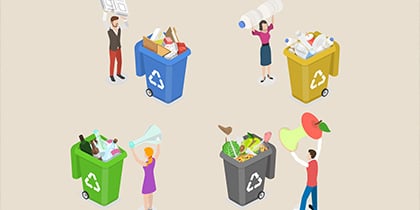
Roadmap: here's how to design an effective labeling and collection system
- Start with the material
Make immediately visible what something is: plastic, cardboard, glass. That forms the basis for recognition. - Use one visual language
Packaging and bin communicate identically: same icons, colors and terms. - Keep the design simple
Limit variants, icons and colors. Less noise = less doubt. - Test in the real world
Try labels in low light, under distraction and with different users. Does it still work then? Then it works everywhere. - Make the system organization-wide consistent
From offices to canteens to warehouses: one logic everywhere. Repetition reinforces recognition, and recognition leads to automatic good behavior. - Integrate flexibility where needed
Some countries separate glass by color, others combine plastic and metal, or use bring points. Use meta-labels, multiple label variations or QR codes for additional context, but always maintain consistent material language.

What this means for companies and chains
Design choices are not theoretical details; they directly determine:
- the sorting quality,
- operational costs,
- the efficiency of collection performance,
- the achievement of circularity goals,
- and employee and customer satisfaction.
Companies that already align their internal systems with the European logic often see quick results: cleaner streams, less error sorting and more efficient processes. Small design decisions yield disproportionate practical as well as circular gains.
Want to do a zero waste challenge yourself?

Stay informed
Follow us on LinkedIn. Here we share the latest news on regulations, circular topics and developments in the industry. You can also subscribe to our newsletter. Curious what Milgro can mean for your operations and waste processes? Feel free to get in touch.
.jpg?width=380&name=Uitgelichte%20afbeelding%20(94).jpg)