

An important step toward a circular economy is social innovation: how we work together, make decisions and change our behavior. In this blog you will read what exactly social innovation is, why it is important for the circular economy and how organizations are putting it into practice.
What is social innovation?
Social innovation means consciously changing collaboration, decision-making and behavior to make progress toward a circular economy.
In our podcast Grondstof tot nadenken , Mathijs Koper, Managing Director & Partner at Tekkoo, gave a recognizable example of social innovation. In the Netherlands, an estimated 27 million old smartphones lie unused in drawers. Of those devices, over 8.6 million can be repaired and resold; the rest can still provide value through recycling.
Mathijs explained, "I always give my children a used phone or laptop. They look at me weird then, but it has impact." This seems like a small step, but it is an example of social innovation: encouraging conscious behavior and normalizing the use of refurbished products.
Why is social innovation important?
Our economy consumes far more resources than the Earth can replenish annually. Earth Overshoot Day shows that: as of July 24, we have already used more resources this year than the Earth can replenish in an entire year. We now live as if we have 1.7 Earths at our disposal.
Climate change, economic growth and geopolitical tensions are increasing pressure on resources worldwide. The need to act circularly is more important than ever. Milgro research shows that 42% of Dutch companies depend to a greater or lesser extent on scarce raw materials; 19% even see this scarcity as a concrete business risk.
Social innovation is an important part of realizing the circular economy. Through behavioral change , people make more conscious choices, for example about waste separation, thus preventing litter. With better decision-making, organizations can make targeted choices for circular solutions and include them in their strategy and investments. In addition, collaboration throughout the chain-from producer to processor and recycler-makes it possible to reuse materials and better align processes. For example, a product may appear sustainable when designed, but if the recycler cannot separate or process the material, it may still end up as waste.
Examples of social innovation in practice
Social innovation is all about positively changing behavior, decision-making and collaboration. You can read what that looks like in practice in the examples below.
Changing behavior in practice: a form of social innovation
Earlier in this blog you read an example of Mathijs Koper, guest in our podcast Grondstof tot nadenken, who stimulates behavioral change in his children by buying them refurbished laptops.
You can also achieve behavior change within the business world. The following example is relevant for healthcare institutions, educational institutions and government organizations where you can encourage behavioral change around waste separation.
Example from practice
Achieving behavioral change is an important part of social innovation and something that organizations can, in some cases, manage directly. During the Week of the Circular Economy Milgro investigated with students how the design of waste separation affects behavior.
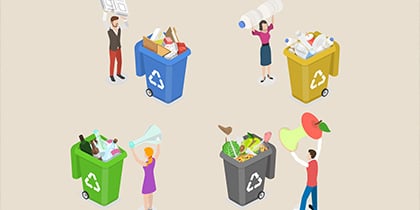
Much litter occurs because people do not know where their waste belongs. Awareness is therefore the first step towards behavioral change. To find out how that works in practice, students were given a bag of mixed waste and tested three different collection arrangements and bins. As they made choices, we observed: where did separation come naturally, where did doubt arise and what role did the type of bin play?
The results were striking. Although only 20% of the youth called themselves conscious and purposeful when it came to waste separation, almost everyone tried to separate waste correctly once the environment was clearly and logically arranged. This shows: proper waste separation behavior can be encouraged.
Based on these insights, we published a report with practical tips to make waste separation easier. With these, educational institutions, governments and healthcare institutions can put behavioral change and thus social innovation into practice.
Decision-making in practice: a form of social innovation
An example of social innovation in decision-making is an organization that decides to buy sustainably. This not only looks at price and availability, but also at products that are reusable or recycled. In this way, decision-making shifts from exclusively cost to also include environmental impact. That decision-making starts with awareness of the added value of sustainable purchasing. This plays a role in the entire process of social innovation: people will only exhibit different behavior or make different decisions if they understand why it is important. If you want to get started with social innovation as an organization, it is important to pay extra attention to this.
Chain cooperation in practice: a form of social innovation
An example of social innovation in cooperation is RetourMatras, where chain cooperation was applied in practice.
Millions of old mattresses are collected every year in the Netherlands. In the past, these often ended up in the incinerator, but producers, retailers, collectors and recyclers have joined forces. Together they developed a single return flow: consumers can hand in their old mattresses free of charge at stores or environmental streets, after which RetourMatras collects and disassembles them. Materials such as foam and steel are reused for new products, including insulation material and new mattresses.
This is a clear example of collaborative social innovation: companies that previously each had their own waste process are now joining forces and sharing responsibility for a circular solution for old mattresses that would otherwise end up as waste. This collaboration creates a solution that one organization alone could not have achieved.
Sustainable innovation
In addition to social innovations, sustainable innovations can accelerate the transition to a circular economy. Consider, for example, designing products that are easier to recycle, repair or reuse.
But what do these innovations look like in practice? And what can they bring to your company? Gijs Derks, Managing Director at Milgro, talks about that with Mathijs Koper, Managing Director & Partner at Tekkoo.
In this episode you will hear, among other things:
- Which sustainable innovations are being used to conserve raw materials.
- What risk companies run if they do not start working with sustainable innovations.
Stay informed
Want to stay up to date with the latest developments? Follow us on LinkedIn and Instagram or subscribe to our newsletter. Curious about what Milgro can do for your operations and waste process? Feel free to get in touch .
Stay informed
Follow us on LinkedIn. Here we share the latest news on regulations, circular topics and developments in the industry. You can also subscribe to our newsletter. Curious what Milgro can mean for your operations and waste processes? Feel free to get in touch.
.jpg?width=380&name=Uitgelichte%20afbeelding%20(79).jpg)