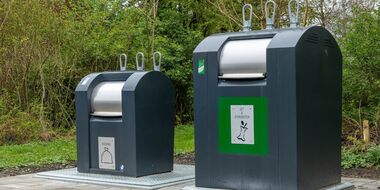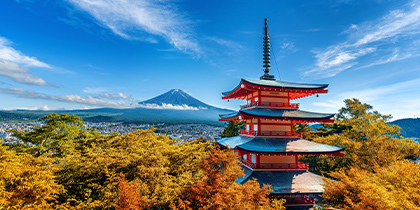


From the moment you set foot on Japanese soil, it is immediately noticeable: there are hardly any trash cans on the streets. And yet the place is clean. Not because of an army of street sweepers, but because of behavior. In Japan, you just take your trash home with you.
In this blog series we look beyond the borders of the Netherlands and Belgium. Because how do other cities and countries deal with their waste streams? What can we learn from them- and what not? In this blog we zoom in on Japan: the land of sushi and samurai, of cherry blossoms and the global metropolis of Tokyo with more than 37 million inhabitants.
The power of culture in waste collection
In Japan, waste collection is not a technical problem but a social contract. Cleanliness is seen as an expression of respect - for others, for the environment and for yourself. You don't leave a mess in someone else's space. And if you do make one, you take it with you. This is reflected in the garbage system:
- There are hardly any public trash cans. Even at train stations and on busy streets, you hardly find any trash cans. People take their trash home with them.
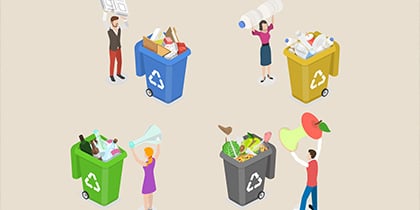
- Strict waste separation at home. Households sort their waste into more than 10 categories, including paper, plastic, cans, PET bottles, textiles and bulky waste.
- Clear instructions per neighborhood. Municipalities provide a schedule and explanation booklet for each neighborhood, detailing exactly on which days which type of waste is collected and how it should be presented to processors.
- Fines for improper separation. Those who do not follow the rules can count on high fines. These run to around 200 euros. This keeps the motivation to separate properly high.
What if we did this in the Netherlands and Belgium?
In the Netherlands or Belgium, such a system would probably quickly lead to problems. After all, without street garbage cans, waste easily ends up on the ground. The Japanese model works only because of a shared norm: "Waste is your responsibility." That norm is deeply embedded in upbringing, education and a strong sense of community.
Technology and incineration
Japan recycles much of its packaging, but at the same time burns a lot of residual waste. This is done in modern and relatively clean plants that generate heat for homes. It fits with Japan's commitment to efficiency and space saving. At the same time, it makes it clear that even exemplary behavior does not automatically lead to a fully circular system.
Climate and law: what is the impact?
Japan is an economic superpower with a strong technological edge - but also a large emissions. That is precisely why the recent ruling by the International Court of Justice on the right to a liveable climate places additional responsibility on this country. As a result, Japanese companies in particular are under more pressure to produce more responsibly, even beyond their own borders. As a result, investments in waste prevention, reuse and local recycling are becoming increasingly important.
The lesson of Japan
Japan shows that behavior can be a foundation for effective waste management - something still often underestimated in many countries. Technology, legislation and social norms reinforce each other there. Perhaps this is a lesson other countries can learn from.

Read also
A view of waste from New York
Staying up to date!
Want to stay up to date on all new developments? Follow us onLinkedIn or subscribe to the newsletter. Are you curious about what Milgro can do for your operations and waste process? Then get in touch.
Stay informed
Follow us on LinkedIn. Here we share the latest news on regulations, circular topics and developments in the industry. You can also subscribe to our newsletter. Curious what Milgro can mean for your operations and waste processes? Feel free to get in touch.