


The holidays are coming: time to organize the Christmas party or Christmas drinks in the workplace. During this period, not only more waste is created, but also more food waste. In this blog you will read what the causes are and how you as an organization can prevent food waste during your Christmas drinks or Christmas party.
The spike in food waste during the holidays
Food waste occurs throughout the year, especially during food production and processing. At this stage, an average of 19% of all food is lost. Globally, about one-third of all food is wasted. Within the European Union, this amounts to an average of 132 kilograms per inhabitant per year.
During the Christmas period, waste increases further. Across Europe, waste production increases by 30% and CO2 emissions increase by an average of 650 kilograms per person. This is partly due to the extra food production, more intensive transport and distribution and higher energy consumption during this busy period.
In the Netherlands, two-thirds of people say they always buy too much for the holidays. In addition, 27% indicate that a quarter of the food is thrown away after Christmas. In Belgium, the figures are almost as high: four in five people buy more than they need and 26% admit to wasting more food than during the rest of the year.

Causes of food waste during the holidays
When it comes to Christmas, many people quickly think of coziness and food. With elaborate dinners, breakfasts and lunches, it makes sense that more food will be purchased. Households want to avoid shortages. Because suppose you are sitting across from each other at Christmas dinner and there is one more piece of the savory pie left, who will take it? Supermarkets cleverly capitalize on this with extra stocks and attractive offers.
Companies also contribute to the increase in food waste during this period. During Christmas parties and end-of-year celebrations, too much food is often structurally ordered. This is also known as overcatering . Many organizations find it difficult to properly estimate how many guests are actually coming, for which food is regularly left over and eventually thrown away after the drinks or lunch.
How can we reduce food waste during the holidays?
With proper preparation, you can largely prevent food waste. Are you starting to invite employees to Christmas drinks or Christmas dinner? Then work with fixed check-in and check-out times. That way you know exactly how many people you have to take into account. Clearly state that last-minute cancellations are not desirable, unless there is an urgent reason. This will prevent you from buying a lot and ending up with a surplus.
In addition,avoid the usual buffer stock of 20% extra and instead base yourself on dates and experiences from previous years. Did a lot have to be thrown away last year? Then you can buy less this year.
Choose local and sustainable products
Haven't decided yet on the food served at your organization's Christmas party? Try working with local suppliers. By doing so, you not only support regional entrepreneurs, but also reduce the number of transport movements and thus CO2 emissions.
In addition, it is valuable to use seasonal vegetables. Seasonal vegetables have a lower impact on the environment because they are produced locally and without energy-intensive cultivation.
Food scraps
To avoid throwing away unnecessary food, give leftover snacks to employees. Have them bring a container from home to do so. That way you avoid extra packaging waste.
Any food left over after the event? Hand it out the next day at the office during lunch or coffee break. This is an easy way to avoid waste.
Are there any leftover food afterward? Then in many cases you can dispose of them in swill waste. Swill waste consists of organic kitchen waste and food scraps that are suitable for digestion into animal feed or fermentation. These include cooked or prepared foods, bread, fruit and vegetable scraps. Before discarding, always remember to remove all packaging, toothpicks, foil and other non-organic materials.
Circularity Gap: the impact of food waste
In the second episode of the podcast Grondstof tot nadenken, Gijs Derks and Ivar Hendricks-director and founder of Stockable-dive into the Circularity Gap: the gap between today's linear economy and the fully circular economy.
One of the biggest and often underestimated contributors to waste is the food industry. Worldwide, over a third of all food is lost each year. In this episode, we explore how food waste contributes to the Circularity Gap and where the opportunities lie to prevent it. You will hear gripping case studies and sharp statements.
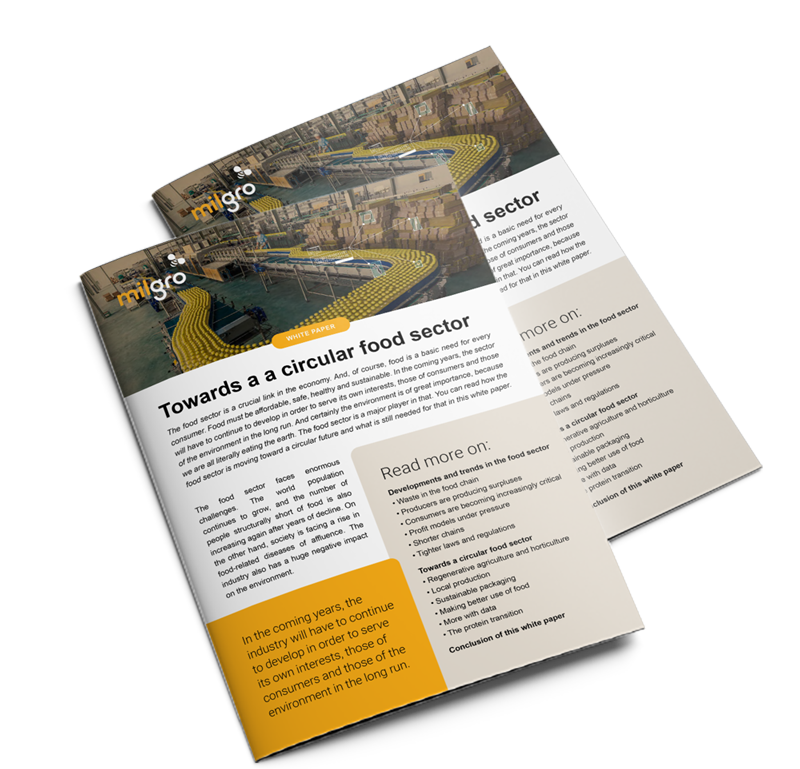
Want to know more about food waste?
Download our whitepaper for free and learn more about the path toward a circular food sector.