


.jpg?upscale=true&width=1600&name=Headers%20(27).jpg)
.jpg?upscale=true&width=768&name=Headers%20(27).jpg)
The Value Gap provides insight into the annual economic losses caused by the linear economy worldwide. It underscores the urgency of the raw materials transition, a topic that is receiving increasing media attention. This new approach comes from the recently released Circularity Gap Report 2026. It’s a staggering figure, but how can entrepreneurs make use of it?
This is the first time the economic loss caused by our current linear economy—based on extracting, using, and discarding—has been calculated in this way. The Circularity Gap Report has been published since 2018. In this annual study, the Circle Economy Foundation sheds light on the state of the circular economy. Whereas in previous years the focus was primarily on the Circularity Gap—which looks at the amount of materials and raw materials extracted, used, and wasted—this year the emphasis has shifted to hard euros: the Value Gap.
But just how high is that staggering amount?
The researchers behind this report have calculated that 25.4 trillion euros in economic value is lost each year due to the linear economy. Trillion. That’s a number with 12 zeros—and it happens every year. An almost incomprehensible figure. Converted into more manageable figures: for every three euros of economic value, one euro is lost due to linear material use. These are structural losses.
The five causes of this loss
The researchers identified five causes for the loss resulting from the still-dominant structure of today’s economy. Losses occur, among other things, during the production of materials and goods. There is also energy loss during production processes. For example, when generating electricity, a significant amount of energy from fossil fuels is lost as heat that is not put to any use. Furthermore, food waste contributes to the Value Gap, as does all the waste generated when products are discarded. Finally, there is significant material loss because buildings, roads, and bridges are demolished or replaced sooner than necessary. This is more than a shame—not only because some of this loss is avoidable, but even more so because the pressure on raw materials and resources will only increase in the coming years, driven in part by population growth and economic growth.
Milgro’s Raw Materials Barometer
Milgro investigated how business owners in the Netherlands and Belgium are experiencing the growing scarcity of raw materials in their own companies. We did this through our own research: the Raw Materials Barometer. And here’s what we found: 78% of the entrepreneurs surveyed in the Netherlands and Belgium are already feeling the effects of the increasingly limited availability of raw materials or other materials. These effects can include, for example, longer delivery times or higher prices. Or worse, materials becoming completely unavailable. It is concerning that this issue is currently being discussed in the boardroom at only 6% of the surveyed companies. Equally concerning—and a sign of vulnerability—is that 28% of respondents lack sufficient insight into which materials and raw materials are scarce and which are not.
Start with insight
It is precisely this lack of knowledge that hits the nail on the head. Change begins with insight. Using our raw materials barometer, companies can identify their own top five critical raw material flows. This Raw Materials Barometer then indicates the steps needed to reduce dependence on these scarce raw materials. In this way, business leaders can narrow their own Value Gap. There is significant potential for gain here, given that we know approximately one-third of the added economic value is lost. In other words, the Value Gap shows how much economic value could potentially be retained if companies manage to use raw materials and other materials more efficiently.
That helps drive systemic change
While using the Raw Materials Barometer is certainly a first and necessary step toward reducing the Value Gap—that is, minimizing the economic losses caused by the linear economy— However, the researchers behind the Circularity Gap Report believe that the ultimate solution cannot be found simply by adding up the proposed measures. What can truly close the Value Gap is a complete transformation of our economic system: from a dominant linear economy to a fully circular economy. Better for corporate profits—and better for the planet. The more entrepreneurs prove they can close their individual Value Gap, the greater the chance that, ultimately, that staggering number with twelve zeros will disappear as well.
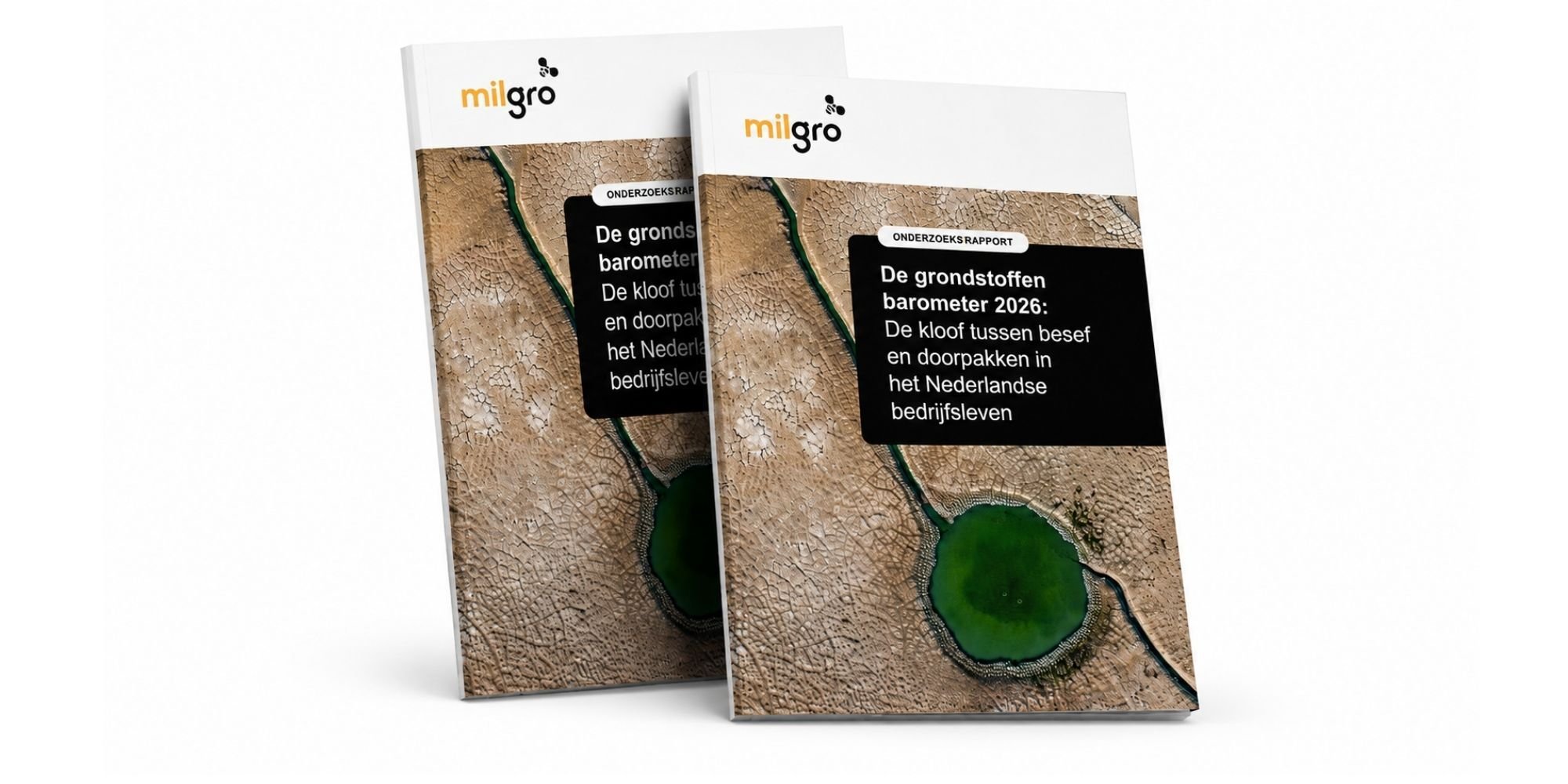
Download our raw matarial barometer
System change can start today. Start by gaining insight into which materials and raw resources are scarce for your organization. Download our raw materials barometer now.

Stay informed
Follow us on LinkedIn. Here we share the latest news on regulations, circular topics and developments in the industry. You can also subscribe to our newsletter. Curious what Milgro can mean for your operations and waste processes? Feel free to get in touch.
.jpg?width=380&name=Uitgelichte%20afbeelding%20(52).jpg)
.jpg)