


Sweden’s west coast features a unique landscape of thousands of rocks, colorful fishing villages, and an endless archipelago of rocky islets. Waste Engineer Aniek Schaeffer recently sailed to Sweden, a country that has been a leader in sustainability for years. Public transportation in the major cities runs on biofuel, and there is significant investment in recycling plants for plastics. But it was outside the city that Aniek first realized just how deeply ingrained that mindset is.
In this blog series, we take a look at waste management beyond the borders of the Netherlands and Belgium. How do other cities and countries handle their waste streams? What can we learn from them—and what should we avoid? These insights help us achieve our mission: a world free of waste.
The red hut by the dock
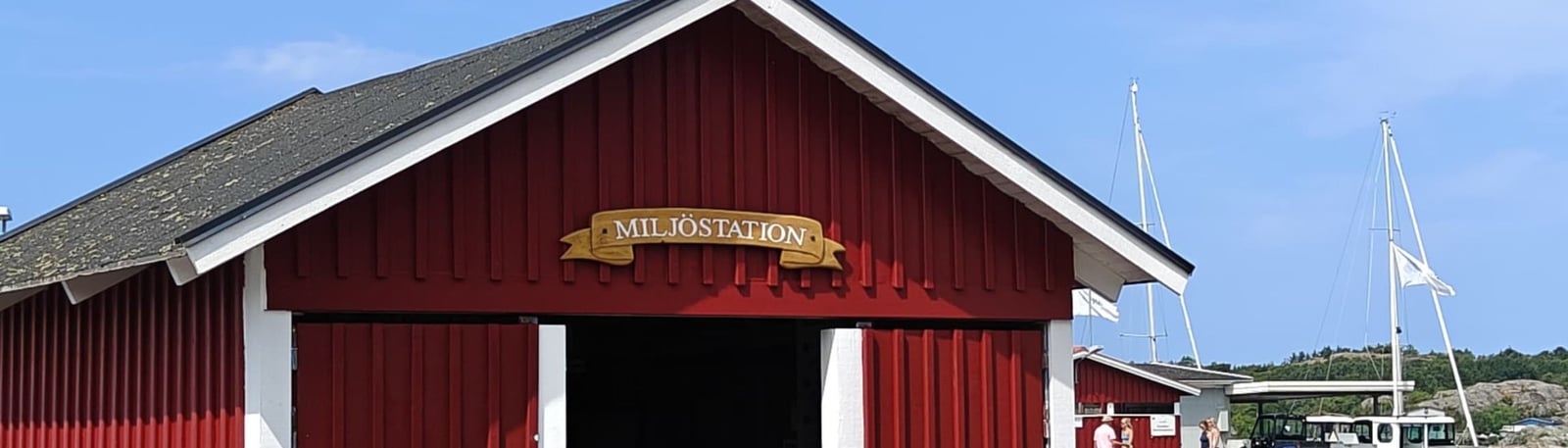
After mooring, the first thing that catches your eye isn’t the harbor itself, but a small building on the shore. Wooden planks, painted dark red, with a pointed roof like the ones you see in almost every Swedish village. “When I saw the pictograms, I thought: wait a minute, this isn’t just a shed.” Inside, clear icons hang above labeled bins: electronics, light bulbs, fluorescent tubes, used oil, paint cans, and batteries. Exactly the kind of waste generated when maintaining a boat—changing engine oil, removing antifouling from the hull, replacing broken navigation lights. “Miljöstation,” it says in elegant letters on the facade.
It’s no coincidence that you’ll find such a facility in Swedish marinas. Since 2002, Swedish law has required marinas to responsibly collect waste from recreational boats. And anyone wishing to display the Blå Flagg certification from Håll Sverige Rent —the blue flag you see flying at marinas and beaches all over the world—must demonstrably meet strict requirements regarding water quality, safety, environmental facilities, and visitor education. An environmental station is a mandatory requirement for this.
The Netherlands has a similar system for small hazardous waste (KGA), though you won’t find it in an authentic little hut—or, in the Netherlands, more likely, a windmill. We can also take a cue from Sweden when it comes to waste separation instructions. Clear waste separation posters are what you’ll find at the environmental stations. “You don’t have to search or hesitate. You walk in, see at a glance where something belongs, and walk right back out,” says Aniek.
.jpg?width=628&height=314&name=Uitgelichte%20afbeelding%20(95).jpg)
Encouraging waste separation in creative ways
A few ports down, Aniek notices something else that stands out. Next to a trash can for cigarette butts hangs a small sign with a “statement of the week,” and two slots below it: agree or disagree. Anyone who throws away their cigarette butt also casts a vote.
“It’s such a simple idea,” says Aniek, “but it works. I saw people actually pause for a moment, read the statement, and only then throw away their butt.”
It’s an interesting approach to behavioral change: creatively encouraging waste separation. Throwing away a cigarette butt thus gets an extra incentive—responding to the statement—which provides just that little bit of motivation to put it in the trash can instead of letting it end up in nature. And it sparks curiosity: what will the statement be at the next trash can?
From Marina to Construction Site
To give her sea legs a bit of a rest, Aniek visits a historic town a few days later. While a building is being renovated, she notices a row of containers lined up next to each other. Not one large bin for everything, but several, each with its own label: drywall, insulation, and metal
Something you don’t often see in the Netherlands, according to Aniek. The reason? At small construction sites, there simply isn’t enough space. So everything ends up mixed together in general waste or construction and demolition waste. “In Sweden, it seems space is deliberately set aside for waste separation,” says Aniek, “both at the marina and on the construction site.”
Still, there’s a slight nuance. Among the neatly labeled containers stands a smaller bin containing a mix of rubble, wood, and stone—materials that could no longer be separated. Interestingly, that bin is noticeably smaller than the separate containers next to it. It’s an interesting principle: by deliberately making the general waste bin smaller than the containers for separated waste, you automatically become more mindful of what you throw away and sort your waste more effectively.
.jpg?width=626&height=313&name=Uitgelichte%20afbeelding%20(96).jpg)
Back on board
Aniek is now back in the Netherlands, where she helps clients organize their waste and resource streams in a smarter and more sustainable way. What sticks with her—besides the fact that Sweden is, in her own words, a beautiful country—is the sum of small choices: a small hut that looks well-maintained rather than merely functional, a rack next to a trash can, and containers with enough space to keep each waste stream separate.
This brings her to the following: “Are you facing a lack of space or a lack of clarity regarding waste streams at your location? Whether it’s a business site or a construction site, contact us todiscover what Milgro can do for your waste management process.”
Stay informed
Follow us on LinkedIn. Here we share the latest news on regulations, circular topics and developments in the industry. You can also subscribe to our newsletter. Curious what Milgro can mean for your operations and waste processes? Feel free to get in touch.
.jpg)