


.jpg?upscale=true&width=1600&name=Headers%20(93).jpg)
.jpg?upscale=true&width=768&name=Headers%20(93).jpg)
Suddenly, VDL Nedcar could barely obtain any chips. These were an essential piece of the puzzle for the cars rolling off the assembly line at its factory in Limburg. As a result, production came to a halt, and some 3,000 employees were forced to temporarily stop working. In recent history, this is one of the most visible examples of how vulnerable supply chains are to shortages of critical materials and components—a situation you’d rather not have to face.
Such a production shutdown is one of the most extreme consequences of a shortage of essential raw materials. Most effects so far have been less far-reaching. Shortages of, for example, one of the 17 designated critical raw materials—such as lithium, cobalt, or graphite—remain limited for now to rising purchase prices and longer delivery times. Nevertheless, this case study does illustrate how dependent companies are on the supply of raw materials for their production—and how this can lead to operational risks.
Consequences Already Noticeable
Milgro recently conducted a survey to determine the extent to which business owners are addressing the risks associated with material shortages affecting their companies and production. Seventy-one percent of survey participants find it concerning that the Netherlands and Europe are so dependent on other countries for raw materials. And 78% are already noticing the scarcity in their own businesses. Materials and raw materials are becoming more expensive, and delivery times are getting longer.
Most business owners see no risks
It is striking that 61% do not yet see any immediate risks to their business operations. This finding seems to lag behind geopolitical developments and the growing uncertainty in international supply chains. The fact that the majority does not yet see any business risks may reflect the fearless and optimistic nature of an entrepreneur. Nevertheless, dwindling raw material inventories make it both urgent and—from the perspective of business continuity and competitive advantage—worthy of inclusion on the board meeting agenda.
Every organization faces its own business risks
This applies not only to companies that rely on these critical raw materials, as listed by the Dutch government. Other materials or raw materials can also become scarce due to a variety of circumstances. Oil is becoming expensive due to geopolitical tensions and the closure of a major transit route. High-quality wood is becoming scarce because more and more construction companies want to use this material for their projects, while forest conservation regulations are becoming increasingly strict. This hot, dry summer has even made water a sought-after resource for all those agricultural businesses that must irrigate their land artificially and purchase additional fuel for their equipment.
From Identification to Analysis
Anticipating scarcity and shortages begins with mapping out the critical material flows within the company. Using a risk analysis, business owners then determine the likelihood that a raw material flow will be disrupted, as well as the potential consequences for customers and the organization’s continuity. A customer may have to wait longer for a product. Or the product may become more expensive. A temporary halt in production causes disruptions in cash flow and may damage the company’s reputation.
Taking Action
The next step is to respond strategically to these risks of raw material shortages. For example, by sourcing materials from multiple suppliers, thereby reducing dependencies. Building strategic inventories is also a way to mitigate periods of scarcity. However, such a buffer and risk diversification are not structural solutions.
And adapting
A more future-proof approach is to explore options for recovering raw materials, through recycling or take-back guarantees. The most sustainable approach is to overhaul the entire product design. Designing products so that components can be reused reduces dependence on new raw materials. As an organization, you’ll be less vulnerable to price increases and supply issues. With creative thinking, the same product can be developed using recycled raw materials and bio-based materials. A circular product design is durable, largely unaffected by trends, modular in structure, and easy to repair.
The LED Bulb as a Good Example
A good example of a company that has adapted its business model to the risks of scarcity is Signify, a manufacturer of LED lights. Signify foresaw long before now that copper, tungsten, phosphorus, and aluminum—which are essential for making the lights—would become increasingly difficult to obtain over time. Furthermore, the company believes it is better for its image and morally responsible to avoid sourcing minerals from regions where there is war or where labor conditions are poor.
Circular Design as a Strategic Choice
So Signify adapted the product design of its lamps to make them circular. Parts of the products are detachable and can be easily replaced. The company also decided to prioritize recycled materials, such as recycled plastic, over virgin materials for its fixtures. In addition, the company established take-back programs so that customers can return their lamps to Signify at the end of their useful life. Finally, Signify has significantly tightened its procurement policy. A thorough audit is conducted for all suppliers with whom Signify has contracts. Through these structural measures, Signify is addressing the risks of raw material scarcity.
Becoming Its Own Supplier
Mattress manufacturer Auping has also reflected on its products and is preparing for potential future shortages. The pile of discarded mattresses keeps growing, and to produce new ones, manufacturers still rely overwhelmingly on chemical base materials derived from fossil fuels—resources that are by no means inexhaustible. With a circular product design for mattresses, Auping is increasingly becoming its own raw materials supplier—and is no longer dependent on external raw materials.
About the Raw Materials Barometer
It is an illusion to think that measures like these can eliminate all associated risks. In a turbulent world, developments can continue to affect companies directly or indirectly. However, with sound risk management, dependencies on raw materials can be significantly reduced.
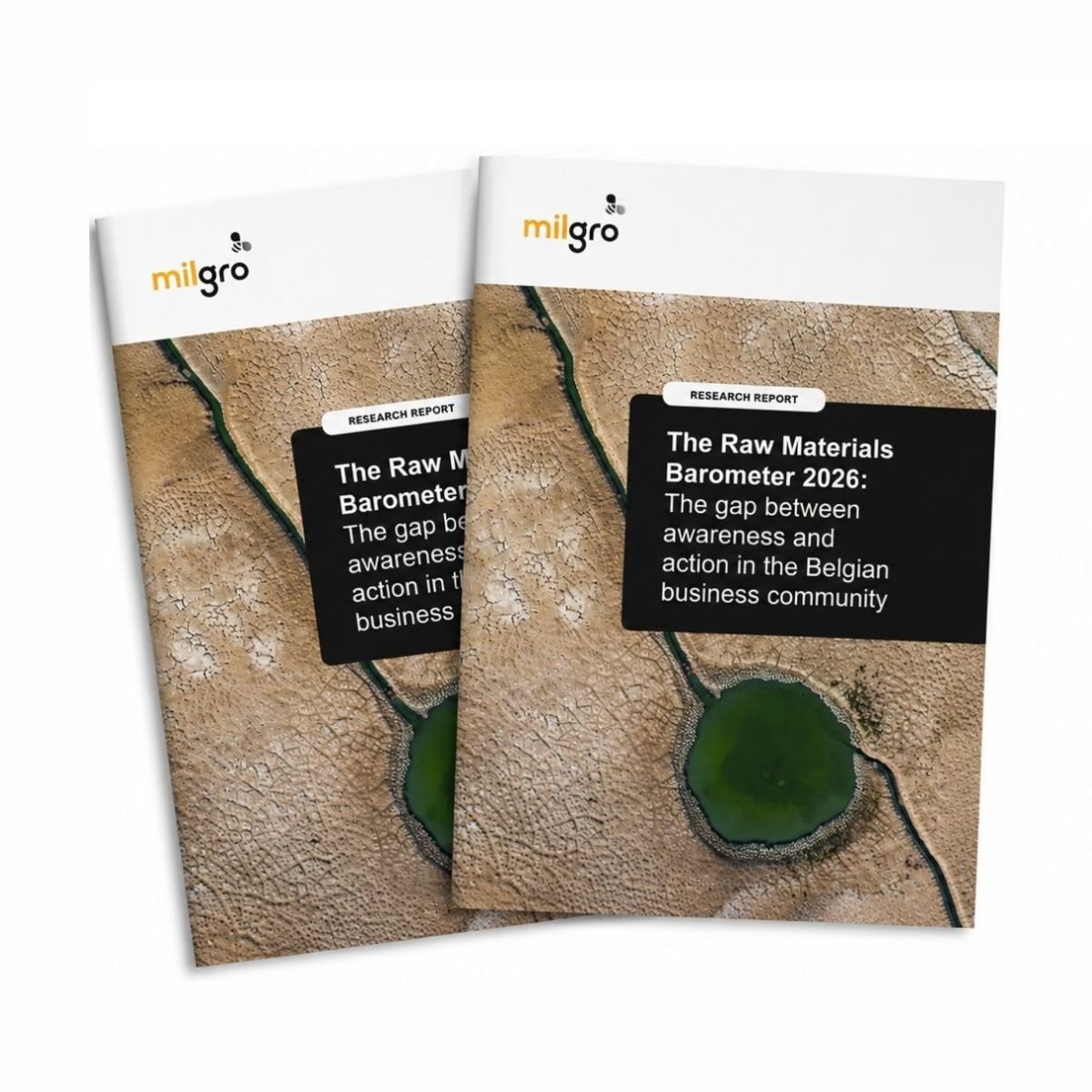
Download the report and learn more
In the research report, you’ll discover how to identify your five most critical raw materials and which steps you can take right away to become less dependent on scarce resources. In this way, together we accelerate the transition to a circular economy.

.jpg)
.jpg)
Stay informed
Follow us on LinkedIn. Here we share the latest news on regulations, circular topics and developments in the industry. You can also subscribe to our newsletter. Curious what Milgro can mean for your operations and waste processes? Feel free to get in touch.
.jpg?width=380&name=Uitgelichte%20afbeelding%20(79).jpg)
.jpg)