


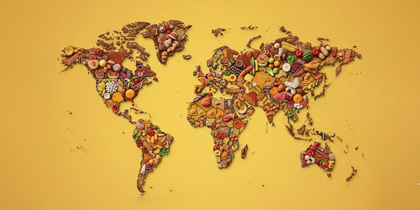
Food waste. A topic that our colleagues on the food team in the Netherlands and Belgium tackle every day. From production lines to food waste streams and packaging: these experts delve into the question of where waste occurs, how it can be reduced, and how it can be prevented. For clients ranging from manufacturers of chips and cookies to fried snacks and even ready-to-eat meals, these experts have already achieved significant optimizations. And that’s necessary. 40% of the food we produce worldwide is wasted. That amounts to 2.5 billion metric tons annually and 80,000 kilograms of food waste per second worldwide.
But how can we really get a handle on food waste? That’s something our experts from Team Food can tell you more about.
When the conveyor belt moves faster than the packaging
Imagine this: you’re standing in a production area for cake fillings. Production is running at full speed, and one cake filling after another lands on the conveyor belt. Yet a large portion of it still ends up being thrown away. This is an issue that Charlotte Jacobs, Circular Economy Officer at Milgro Belgium, recently addressed. And what did she find? Operationally, things were falling apart in a number of areas. There wasn’t enough staff to package the cake fillings, but production continued at the same pace. The result: thousands of kilograms of edible product ending up directly in the dumpster.
Since then, the recommendation has been made to align cake filling production with available manpower, which results in less waste. However, reduced production does not necessarily mean lower profits. After all, the fewer products that end up in the trash unnecessarily, the fewer raw materials are needed to produce the same amount of saleable product. “Purchasing plays an important role in this,” Charlotte explains. “Now that less ends up in the trash, fewer ingredients are needed to produce the same amount of saleable product.”
A product’s origin: an often-overlooked cause of food waste
It’s also important to consider a product’s origin. We’re used to being able to buy mangoes at the supermarket all year, while in Indonesia you can’t find mangoes outside of the season. Out of season, mangoes often come from far away, such as Peru. Mangoes are a fragile fruit: globally, an average of 30 to 50 percent of harvested mangoes are lost before they reach consumers, due to combined losses during harvesting, transport, and storage. This brings us to a broader point: food waste isn’t just about how much food is thrown away, but also about the impact of food production on the planet.
.png?width=682&height=341&name=featured-image-91-english%20(1).png)
.jpg)
Fermentation: Is It the Solution to Food Waste?
Fermentation is a widely used method when it comes to food waste. Too much so, in the view of Riske van Vliet, Waste Engineer at Milgro. “I think there are still many steps to be taken. There are numerous applications where organic waste streams can be processed in a more value-added way. Take animal feed, for example—it’s a few steps higher on the Moerman Ladder.”
The Moerman Ladder is a widely used model in circular food management: the higher up the ladder a waste stream is utilized, the more valuable and circular the application. No one has yet succeeded in producing entirely waste-free, but it offers guidance on how to ensure that what doesn’t end up in the products isn’t thrown away or wasted but is instead put to another use. Fermentation is already ranked higher than composting and incineration, but animal feed is two steps above that. This is an application we’ve already implemented in practice on multiple occasions. Consider ice cream and candy: the organic waste was used as animal feed.
.png?width=682&height=341&name=featured-image-99-english%20(1).png)
This has also been put into practice with potato chips. At one facility, a large quantity of rejected potato chips was generated daily, due in part to packaging errors, product surpluses, and products that did not meet quality standards. The potato chips were still in their original bags and went straight into the dumpster, after which they were disposed of as residual waste.
Together with the company in question, we sought a solution, whereby the potato chips are now separated from their packaging, ground up, and safely used as livestock feed. A concrete example of reducing food waste through repurposing: the chips that would have ended up as waste are now being reused as a raw material.
Making the switch to animal feed isn’t that simple
Crispy shrimp crackers ground up with a small percentage of shrimp meal. Christiaan Hendriks, a Waste Engineer at Milgro who specializes in optimizing waste streams in the food sector, faced this challenge. Because it was precisely that small percentage that posed an obstacle. Shrimp meal, in fact, cannot be fed to ruminants such as cows. As a result, a stream that looked perfectly suitable for animal feed was out of reach for the most obvious buyers.
“We then deliberately set out to find a livestock farmer who was allowed to receive this stream,” says Christiaan. The result: a stream that previously ended up as waste and is now sold as animal feed has grown from approximately 200,000 to 300,000 kilograms per year.
Anyone wishing to sell food as animal feed must comply with GMP+, an internationally recognized certification system focused on animal feed safety. Milgro assists companies with this as a gatekeeper, explains Christiaan. Milgro itself is audited annually by GMP+ to verify that it meets the requirements. If so, Milgro can facilitate verified routes (in accordance with GMP+ guidelines) on behalf of clients, without the client having to organize all processing activities themselves. In doing so, Milgro examines, among other things, labeling and marking, transport documents, the closure of production processes, cleaning protocols, and the prevention of mixing with other streams.
Here’s how Christiaan envisions his ideal world regarding food waste in a year’s time: “Animal feed is an interesting solution, but if we look at the Moerman Ladder, there are still steps to be taken. It would be truly wonderful if a product intended for human consumption could ultimately be used by humans.”
Human consumption as the starting point
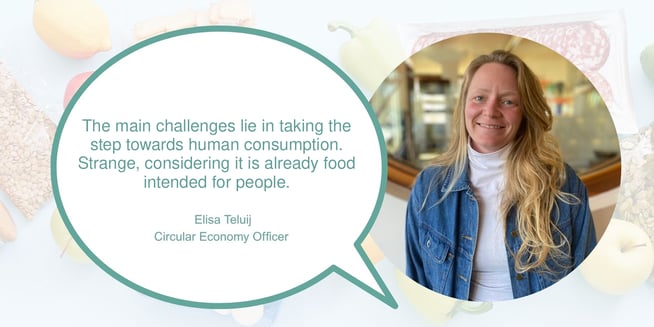
The higher up the Moerman Ladder, the more rules and regulations come into play. This is already the case when moving toward animal feed, though the challenges lie primarily in the step toward human consumption. “It’s strange, because it’s already human food,” says Elisa Teluij, Circular Economy Officer with years of experience in the food sector.
The question that matters: what is the reason for rejection? Often, a parameter is set in the factory to meet a specific quality requirement. But that’s not just arbitrary, Elisa explains. “Internal quality requirements are never broader than those of the NVWA; they can only be stricter.” If a product is rejected due to such an internal standard, there is still a gap between what the company itself allows and what is legally permitted to be sold.
These internal standards rarely come out of nowhere. They’re often determined by the customer, such as a supermarket. For example, one supermarket may impose stricter requirements on suppliers than another. The result is a fixed order on the production line: first, the batch for the strictest customer is produced, followed by the batch for the less strict one. Never the other way around. In practice, the most stringent customer acts as a sort of safety net: any surplus that does not meet the strictest requirements is still put to use through the less stringent batch—provided it meets the NVWA’s requirements—rather than ending up as waste.
Food waste doesn’t stop with the product alone
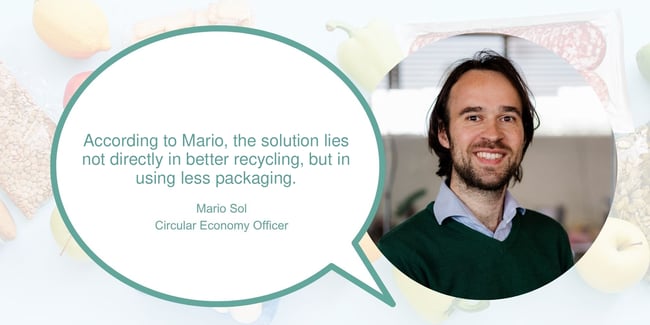
In addition to food waste, there is also waste associated with the packaging in which the food product is wrapped. Take, for example, the plastic packaging around a meal salad. After you’ve eaten the meal salad, you’re left with contaminated packaging full of food scraps. This prevents the plastic from being recycled properly, because the organic residues disrupt the sorting process, cause chemical reactions during melting, and reduce the quality of the new plastic. “This is a challenge for companies in the food industry,” says Mario Sol, Circular Economy Officer at Milgro. According to him, the solution therefore doesn’t lie directly in improving recycling, but in using less packaging. After all, it’s more environmentally friendly for both consumers and producers to use less packaging.
“You see that more and more companies are working on this: they’re receiving more in bulk, and thus less in individual packages.” An example of this is delivering an ingredient directly from a tanker truck and storing it in a silo at the food producer’s facility. For ingredients with a slower turnover, reusable packaging such as IBCs can be used: large, sturdy plastic containers that are cleaned after use and returned to the supplier to be refilled. This way, there is little to no packaging waste generated at the food producer’s facility. “Instead of dozens of small bags or boxes, ingredients now arrive in a single large shipment, with significantly less packaging material per kilogram of product.”
So what’s the golden tip for preventing food waste?
So what’s the golden tip for preventing food waste? Our experts agree: it starts with insight. Insight into where things go wrong—whether in planning on the production floor, in a waste stream that actually deserves a new purpose, or in the packaging itself. “Many companies have no idea how much food is being thrown away, or exactly where that’s happening,” says Charlotte Jacobs. Without that insight, you also don’t know what you can reduce or prevent.
Stay informed
Follow us on LinkedIn. Here we share the latest news on regulations, circular topics and developments in the industry. You can also subscribe to our newsletter. Curious what Milgro can mean for your operations and waste processes? Feel free to get in touch.
.jpg?width=380&name=Uitgelichte%20afbeelding%20(88).jpg)
.png)