


Many organizationsthink of the PPWR first in terms of new design rules, recyclability or reuse. Logical. But in practice, the biggest challenge often lies elsewhere: data. Because you can only test, prioritize and document if you know what packaging you use, what components it contains and what information is available about it.Technical documentation and the declaration of conformity mean that packaging data is no longer "handy to have," but a serious basic requirement toward Aug. 12, 2026.
Toproperly prepare for the PPWR, you want to have visibility into each packaging type, material types, individual components, weights, supplier and the countries in which the packaging will be marketed. Without that data, documentation, prioritization and substantiation becomes a lot harder.
Why packaging data becomes so critical under the PPWR
The PPWR drives packaging that can be shown to meet relevant requirements . That means organizations need to know not only what packaging is being marketed, but also what materials, components and properties go with it. That information is needed to assess where there are risks, to build technical documentation and ultimately to work toward the declaration of conformity. This is precisely why the focus is shifting from "we have about an overview" to "we need to be able to retrieve this in a structured way."

Which minimum packaging data you want to record for each packaging type?
The basics sound manageable, but quickly become larger once you have multiple product groups or markets. For each package, think at least about: the type of packaging, the materials used, the individual components, the weight, the supplier and the countries in which the packaging is marketed. This includes not only the "big package," but also components such as caps, labels, tape, foil, fillers and closures. It is precisely these small parts that are often forgotten in practice, even though they are relevant for documentation, recyclability and substantiation.
Where things most often go wrong in daily practice
The problem is usually not that organizations have no data at all. The problem is that the information is scattered around. Some is in procurement, some in packaging, some in supplier specifications, some in Excel files and some just in someone's head. Add different countries, product lines or private labels, and it quickly becomes cluttered. On top of that, supplier information is not always complete and small components or changes along the way are not tracked tightly enough. That makes "we have data" very different from "we have actionable packaging data."
Why this isn't just a compliance exercise
Good packaging data doesn't just help prove that packaging is compliant later. It also helps to make better choices. Where are there material combinations that are difficult to recycle? Which packaging has many components? Where is crucial supplier information missing? And which product groups are so large that they deserve attention first? In other words, packaging data is not only evidence, but also management information. That makes this step immediately relevant for packaging, procurement and sustainability.
Read also

PPWR Compliance: Are Companies Ready?
How to get started with packaging data for the PPWR in practice
The smartest approach is usually not to describe all packaging perfectly right away. Rather, start with the largest streams or the packaging where you already know that there is a lot of uncertainty in terms of material choice, components or supplier data. Make an inventory per product group of the packaging in circulation, make visible which information is missing and bring as much data as possible together in one place. From there you can build files, complete documentation and work towards the declaration of conformity. This keeps it manageable and strategic.
The core: no sharp preparation without data
Organizations that get a grip on packaging data now will not only run less risk of delay towards 2026, they will also make it much easier for themselves to prioritize, document and improve. This is precisely why this is such an important step in preparing for the PPWR. Not sexy perhaps, but defining.
Need help preparing for the PPWR?
Our webinar will give you practical tools to get your organization ready. Afterwards, you'll know how to effectively apply the principles of reduce, reuse and recycle. Watch it here! Or would you like to know which role you have, which packaging needs attention and which data you need to put in order now? In the PPWR starter kit you will find a practical step-by-step plan, a separate checklist and extra information to help you work towards August 12, 2026.
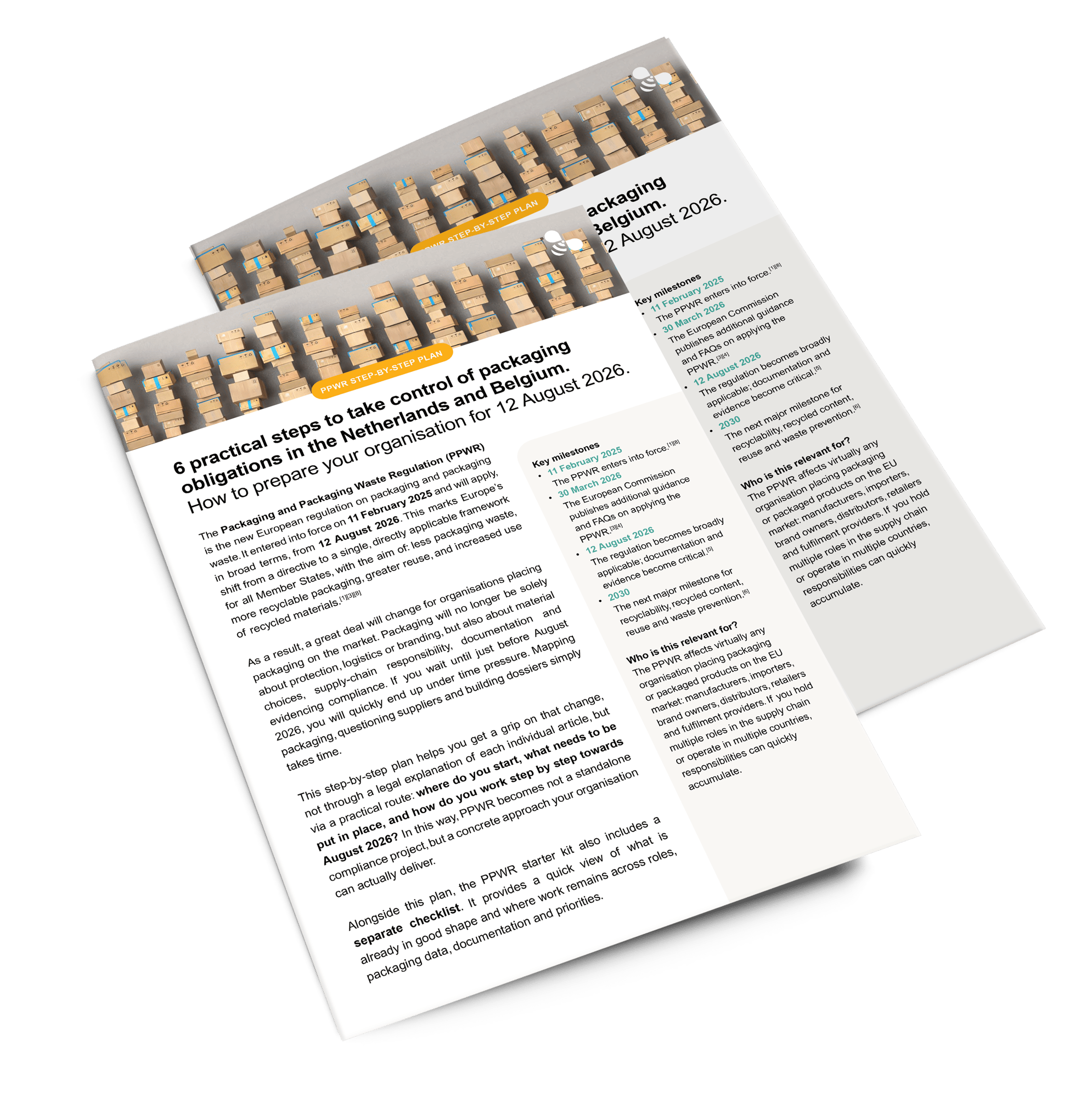
Get ready for PPWR with the free step-by-step guide

Stay informed
Follow us on LinkedIn. Here we share the latest news on regulations, circular topics and developments in the industry. You can also subscribe to our newsletter. Curious what Milgro can mean for your operations and waste processes? Feel free to get in touch.

.jpg?width=380&name=Uitgelichte%20afbeelding%20(94).jpg)