




Government biggest obstacle to circular business.
Rotterdam, June 3, 2025 - Dutch organizations are falling behind on circularity goals. Currently, only a quarter of companies (23%) are largely or fully circular. This is according to research by waste and resources manager Milgro among 311 decision makers. Conflicting regulations (21%), a lack of internal urgency or support (20%) and the high cost of circular solutions (16%) are cited by organizations as the main obstacles to becoming fully circular.
From ambition to action
To give direction to circular growth, it is important to know how far companies are already with circularity, what steps they are taking and what they are up against. We surveyed 500 companies in the Netherlands and Belgium.
Although many organizations lag behind on their circularity goals, 33 percent of the companies do have the ambition to become more sustainable. For example, one-third of the decision makers say they want to operate largely circularly within five to ten years. To realize that ambition, companies are currently focusing primarily on three action items: reducing waste production (69%), sustainable procurement (60%) and using recycled materials (46%). In addition, efforts are being made to reuse or refurbish products (38%), cooperation within the chain to promote circularity (32%) and the use of renewable energy sources (30%).
To measure is to know
For many companies, however, measuring circularity proves challenging. For example, one in five organizations (20%) indicate a need for more insight into measurement methods and circular KPIs, in order to steer more specifically towards circular objectives. Remarkably, 28 percent of companies do not yet use circular KPIs at all. Among organizations that do have established KPIs, the emphasis is mainly on waste reduction (49%), CO2 emissions related to production (36%), product lifecycle and reuse (27%) and the proportion of recycled materials in production (26%).
Gijs Derks, director at Milgro: "Many organizations are still in the early stages of circular entrepreneurship. They take loose measures, look for direction and build internal support. But circularity is rapidly professionalizing. Companies that lag behind not only have to deal with stricter legislation, but also increasing costs. Raw materials are becoming scarcer and more expensive, and inefficient use of them directly affects business operations. Those who have to start now risk failing to meet the European goal of a fully circular economy by 2050. Not starting is simply not an option. My advice is: be ahead of the legislation, set your course, control your costs and take the first step today. Companies that stand still will soon be behind the times."
About the research
Commissioned by Milgro, Markteffect conducted a survey of 464 decision makers in the Netherlands (311) and Belgium (153) in April 2025. The target group consisted of senior and middle management, with responsibilities in procurement, facility management, environment or sustainability. All sectors of the Dutch business community were represented, giving the survey a representative picture of the state of circularity within organizations in the Netherlands.
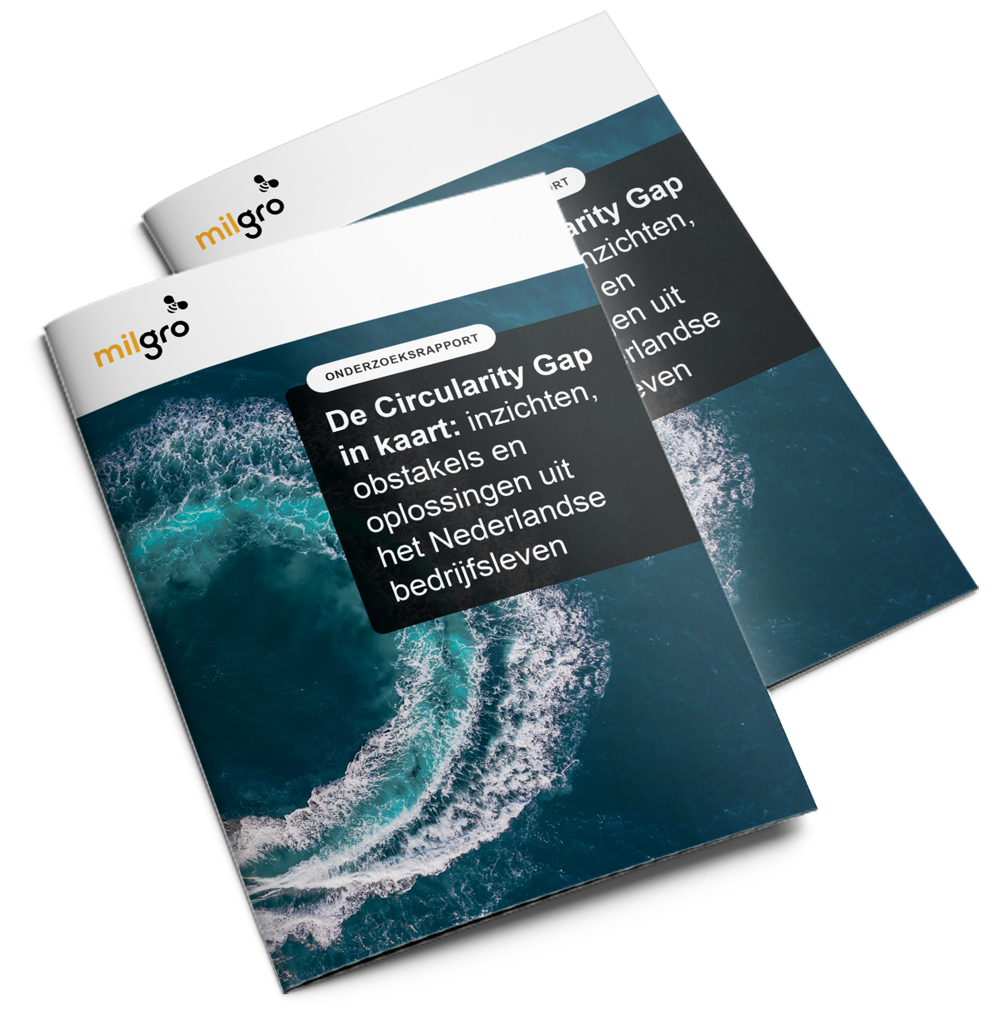
The research revealed surprising and urgent findings.
The results have been compiled into two separate reports: one for the Netherlands and one for Belgium. This gives you direct insight into the developments relevant to your market.


Stay informed
Follow us on LinkedIn. Here we share the latest news on regulations, circular topics and developments in the industry. You can also subscribe to our newsletter. Curious what Milgro can mean for your operations and waste processes? Feel free to get in touch.
.jpg?width=380&name=Uitgelichte%20afbeelding%20(24).jpg)